
Reaching the first 10 lakhs in sales is an exciting milestone for any ecommerce marketplace seller. It proves that customers like your products and that your business has real potential. Many sellers celebrate this achievement because it takes months of hard work, product research, listing optimization, advertising, and customer service to get there.
However, something interesting happens after this stage.
Sales stop growing.
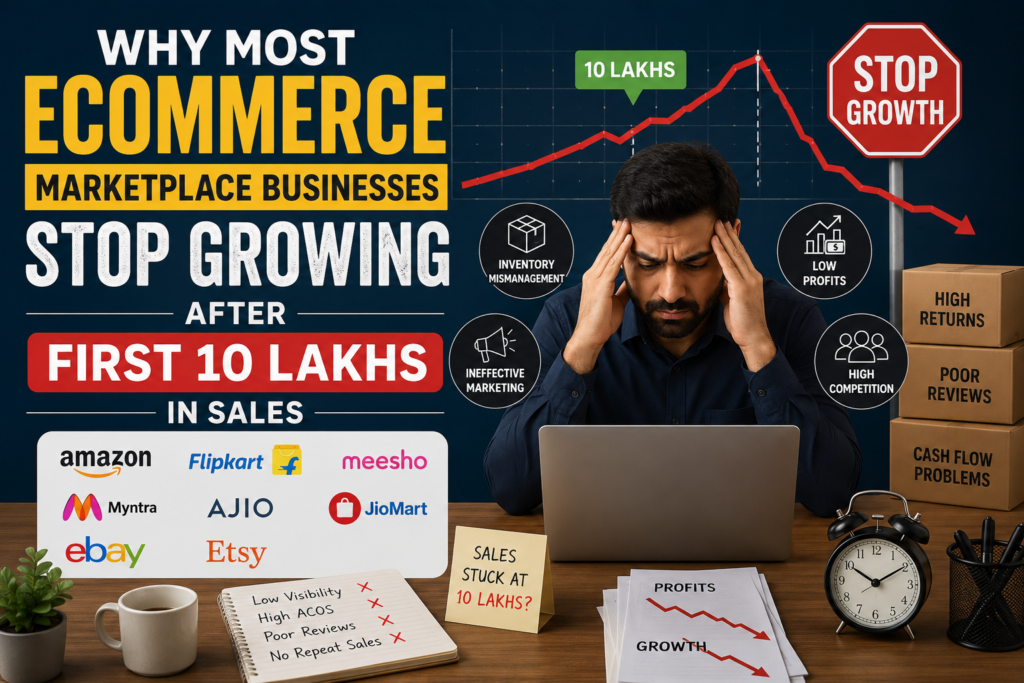
Orders become inconsistent. Advertising costs increase. Profit margins become smaller. Inventory problems appear more often. Competition becomes tougher. The same strategies that helped you reach your first 10 lakhs suddenly stop delivering the same results.
This is one of the biggest reasons on ecommerce marketplace why thousands of sellers remain stuck for years without reaching the next level.
The good news is that this problem is completely avoidable. Once you understand why growth slows down, you can build a stronger business that continues to grow across ecommerce marketplaces like Amazon, Flipkart, Meesho, Myntra, Ajio, Jiomart, Etsy, and Ebay.
In this article, we will explore the most common reasons why an ecommerce marketplace business stops growing after the first 10 lakhs in sales and what successful sellers do differently.
Growth Requires a Different Mindset
Many sellers believe that increasing sales is simply about spending more money on ads.
Unfortunately, ecommerce marketplace business growth does not work that way.
Getting your first few lakhs usually depends on finding one or two products that customers like. Scaling beyond that requires systems, planning, data analysis, inventory management, pricing strategy, and continuous optimization.
A business that operates exactly the same way after reaching 10 lakhs will usually struggle to reach 50 lakhs or even 1 crore.
Growth demands better decision making rather than simply working harder.
Sellers Depend Too Much on One Product
One of the biggest mistakes in any ecommerce marketplace business is relying on a single bestselling product.
Initially, this product generates consistent sales and healthy profits. Everything seems perfect.
Then competitors notice your success.
Soon, similar products begin appearing on ecommerce marketplaces like Amazon, Flipkart, Meesho, and other marketplaces. Prices start falling. Advertising becomes expensive. Your visibility slowly decreases.
Now the entire business depends on one product that is no longer performing like before.
Successful sellers continuously expand their catalog with related products instead of waiting for sales to decline.
A broader product range creates more opportunities for repeat purchases while reducing business risk.
Inventory Planning Becomes a Bigger Challenge
Running out of stock is one of the fastest ways to slow business growth on ecommerce marketplaces.
Many sellers underestimate future demand.
During sales events, products suddenly become unavailable because inventory was not planned properly.
When listings remain out of stock for several days on ecommerce marketplace rankings begin to drop. Organic visibility decreases. Advertising performance weakens. Recovering those rankings often takes weeks or even months.
On the other hand, overstocking creates another problem.
Money remains locked in slow moving inventory that could have been invested in new products or marketing.
Good inventory planning keeps products available without unnecessarily increasing storage costs.
Advertising Starts Replacing Organic Sales
Advertising helps new products gain visibility on ecommerce marketplace.
The problem begins when businesses become completely dependent on paid traffic.
Many sellers continue increasing advertising budgets without improving listings, product images, or customer experience.
Eventually, advertising costs rise while profits fall.
A healthy ecommerce marketplace business maintains a balance between paid traffic and organic visibility.
Better product titles, stronger keywords, attractive images, positive reviews, and competitive pricing all contribute to organic rankings that reduce advertising dependence.
Product Listings Stop Improving
Many sellers optimize their listings once and never revisit them.
Meanwhile, customer preferences continue changing.
Competitors upload better images.
New keywords become popular on ecommerce marketplace.
Search behavior evolves.
Marketplaces regularly update their search algorithms.
A listing that performed well last year may no longer perform as effectively today.
Successful sellers regularly improve their listings by updating titles, bullet points, descriptions, images, videos, and backend keywords.
Continuous optimization often produces better results than constantly increasing advertising budgets.
Customer Reviews Are Ignored
Reviews influence almost every purchase decision.
Many businesses focus only on getting more orders while paying little attention to customer feedback.
Negative reviews often reveal recurring issues such as sizing problems, packaging damage, missing accessories, unclear instructions, or quality concerns.
Ignoring these issues eventually reduces conversion rates.
Successful sellers carefully analyze reviews because they provide direct insights into customer expectations.
Even small product improvements based on customer feedback can significantly increase long term sales.
Pricing Becomes the Only Strategy
Price wars are common across every ecommerce marketplace.
When competitors reduce prices, many sellers immediately do the same.
This creates a race toward lower profits.
Instead of constantly reducing prices, experienced sellers focus on increasing perceived value.
Better packaging.
Improved product presentation.
Higher quality images.
Clearer product descriptions.
Helpful comparison charts.
Excellent customer support.
Fast delivery.
These factors often justify slightly higher prices while maintaining healthy profit margins.
Marketplace Data Is Not Used Properly
Every order generates valuable information.
Which products receive the highest clicks?
Which keywords generate conversions?
Which advertisements waste money?
Which cities order most frequently?
Which products have high return rates?
Many sellers never analyze these reports.
Instead, they make business decisions based on assumptions.
Data driven decisions reduce risk because they rely on actual customer behavior rather than guesswork.
Regular performance reviews help identify both problems and opportunities before they become serious.
Businesses Expand Too Quickly
Growth can create excitement.
Some sellers immediately launch dozens of new products after reaching early success.
Unfortunately, rapid expansion without proper research often leads to poor inventory decisions.
New products require capital, advertising, photography, listing optimization, and customer support.
Launching too many products at once spreads resources too thin.
Successful businesses expand gradually while ensuring existing products continue performing well.
Steady growth is usually more sustainable than rapid expansion.
Operations Become Difficult to Manage
When sales increase, daily operations become more complicated.
Order processing takes longer.
Inventory updates become slower.
Customer queries increase.
Returns become more frequent.
Many businesses continue managing everything manually.
This eventually creates delays and mistakes.
Successful sellers build systems that simplify routine tasks.
Automation, standard operating procedures, and clear responsibilities improve efficiency while reducing operational stress.
Selling on Only One Marketplace Limits Growth
Many businesses begin with Amazon or Flipkart because these marketplaces have large customer bases.
While this is a good starting point, relying on only one platform increases business risk.
Every marketplace has different customer preferences.
Some categories perform exceptionally well on Meesho.
Fashion brands often perform strongly on Myntra and Ajio.
Regional demand may be stronger on Jiomart.
Handmade and personalized products often find loyal buyers on Etsy.
International demand can be explored through Ebay.
Expanding to multiple platforms creates additional revenue opportunities while reducing dependence on a single marketplace.
Customer Retention Is Often Forgotten
Many sellers focus only on acquiring new customers.
Returning customers are often ignored.
A satisfied customer who purchases multiple times is usually more profitable than constantly finding new buyers.
Providing accurate product information, consistent quality, reliable delivery, and responsive customer support encourages repeat purchases.
Strong customer satisfaction also increases positive reviews and recommendations.
Both contribute to sustainable business growth.
Competition Keeps Improving
Many sellers believe reaching 10 lakhs means they have mastered the market.
The reality is quite different.
New competitors enter every month.
Existing brands improve their listings.
Advertising strategies become more sophisticated.
Customer expectations continue rising.
Standing still allows competitors to move ahead.
Continuous learning helps businesses remain competitive.
Successful sellers regularly study market trends, competitor listings, customer reviews, and marketplace updates.
Strong Financial Planning Matters More Than Sales
Revenue is exciting.
Profit is essential.
Many businesses celebrate higher sales while overlooking shrinking margins.
Hidden costs slowly reduce profitability.
Advertising expenses increase.
Marketplace commissions rise.
Returns become more frequent.
Storage fees grow.
Packaging costs increase.
Without proper financial tracking, sales may appear healthy while actual profits continue falling.
Understanding product wise profitability helps businesses make better investment decisions and avoid unnecessary losses.
What Successful Ecommerce Marketplace Businesses Do Differently
Businesses that continue growing beyond 10 lakhs usually share several habits.
They regularly analyze performance reports.
They improve listings instead of leaving them unchanged.
They invest in product quality.
They monitor customer feedback carefully.
They diversify their product catalog.
They maintain healthy inventory levels.
They focus on profitability rather than only sales volume.
They expand thoughtfully across marketplaces such as Amazon, Flipkart, Meesho, Myntra, Ajio, Jiomart, Etsy, and Ebay.
Most importantly, they treat growth as an ongoing process rather than a single achievement.
Frequently Asked Questions
Why do ecommerce businesses stop growing after 10 lakhs in sales?
Most businesses stop growing because they rely on the same strategies that helped them achieve early success. Common reasons include poor inventory planning, dependence on one product, rising advertising costs, weak listing optimization, and lack of data analysis.
Should sellers expand to multiple marketplaces?
Yes. Selling on multiple marketplaces reduces business risk and creates new revenue opportunities. Different platforms attract different customer segments and product categories.
Is advertising enough to scale an ecommerce marketplace business?
No. Advertising can increase visibility, but sustainable growth also depends on product quality, optimized listings, customer reviews, inventory management, pricing strategy, and operational efficiency.
How often should product listings be updated?
Listings should be reviewed regularly. Updating keywords, images, descriptions, and product information helps maintain visibility as customer search behavior and marketplace algorithms evolve.
Conclusion
Growing an ecommerce marketplace business beyond the first 10 lakhs is not about working longer hours or simply increasing advertising budgets. It requires smarter planning, better systems, stronger product selection, and continuous improvement across every part of the business.
The businesses that continue growing are not necessarily the ones with the biggest budgets. They are the ones that consistently learn from data, listen to customers, improve their listings, and make thoughtful decisions based on long term goals rather than short term sales.
If your growth has slowed, consider it an opportunity to evaluate what needs improvement rather than a sign that your business has reached its limit. Small changes made consistently can create meaningful results over time. By focusing on the fundamentals and adapting as your business grows, your ecommerce marketplace journey can continue well beyond the first 10 lakhs in sales.