
Starting an online business has never been easier, but choosing the right platform has become more confusing than ever. Many business owners ask the same question before launching or expanding their brand. Should they sell on Amazon, Flipkart, or Shopify?
There is no single answer because every business has different goals, budgets, and growth plans. A platform that works well for one seller may not be the right choice for another.
One thing is certain. No matter which platform you choose, proper flipkart, shopify & amazon account management and overall business management play a major role in long term success. Many sellers focus only on listing products, but sustainable growth depends on much more than that. Product visibility, customer experience, inventory planning, account performance, and daily operations all contribute to consistent sales.
This guide compares Amazon, Flipkart, and Shopify from a practical business perspective. Instead of looking only at features, we will understand which platform fits different business models and what you should expect before investing your time and money.
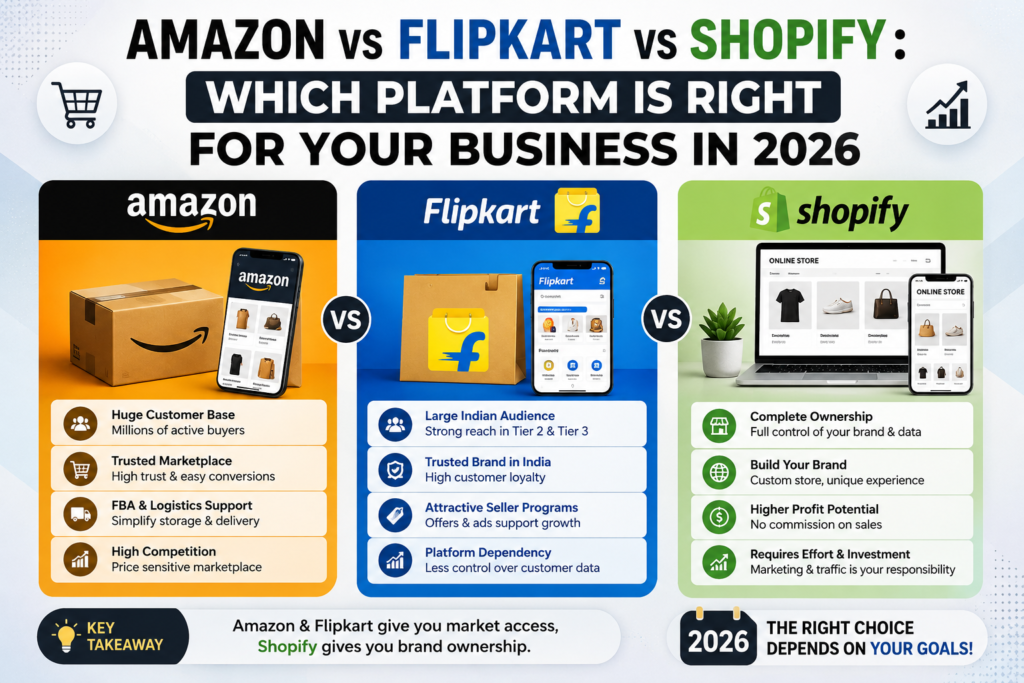
Quick Comparision Table
| Feature | Amazon | Flipkart | Shopify |
| Customer Traffic | Very High | High | You Build You Own |
| Brand Control | Limited | Limited | Complete |
| Initial Investment | Low | Low | Moderate |
| Marketing Responsiblity | Low to Medium | Low to Medium | High |
| Competition | Very High | High | Depends on Your Marketing |
| Profit Margin Control | Moderate | Moderate | High |
| Scalibility | Excellent | Excellent | Excellent |
Understanding the Difference Between Marketplaces and Your Own Store
Before comparing platforms, it is important to understand how they actually work.
Amazon and Flipkart are marketplaces.
Customers already visit these platforms every day looking for products. Your job is to make your product visible among thousands of competitors.
Shopify is different.
It allows you to build your own ecommerce website. Customers will not automatically visit your store. You are responsible for bringing traffic through SEO, social media, paid advertising, email marketing, and content marketing.
This simple difference changes almost every aspect of running an online business.
Amazon Is Best for Businesses Looking for Immediate Reach
Amazon remains one of the largest ecommerce marketplaces in the world. Millions of customers search for products every day, giving new sellers access to ready buyers.
This makes Amazon attractive for businesses that want faster sales without spending months building a website audience.
However, high customer traffic also means higher competition.
Thousands of sellers may offer similar products.
This is where professional amazon account management becomes important.
Success on Amazon depends on several factors including product listing quality, pricing strategy, customer reviews, account health, and advertising performance.
Many sellers underestimate the importance of seller account optimization. Optimized product titles, informative descriptions, relevant keywords, quality images, and proper backend settings improve product visibility and conversion rates.
Businesses that regularly improve their listings usually perform better than sellers who upload products once and never update them.
Advantages of Selling on Amazon
Amazon offers several benefits for growing businesses.
Large customer base.
Strong buyer trust.
Fast order fulfillment through Amazon fulfillment services.
Powerful advertising options.
Access to detailed business reports.
International expansion opportunities.
For businesses planning long term growth, consistent account monitoring helps identify performance issues before they become serious.
Challenges of Selling on Amazon
Amazon is highly competitive.
Advertising costs continue increasing in many product categories.
Marketplace policies frequently change.
Account performance must remain healthy to avoid restrictions.
Sellers also need strong amazon account health inventory management practices because running out of stock can reduce rankings and affect future sales.
Inventory planning becomes especially important during seasonal sales.
Flipkart Is Strong for the Indian Market
Flipkart continues to be one of India’s most trusted ecommerce platforms.
Many product categories perform exceptionally well because of its large domestic customer base.
For businesses focused mainly on Indian customers, Flipkart provides an excellent opportunity to build sales without investing heavily in independent website marketing.
Competition exists, but it is generally lower than Amazon in several categories.
This creates opportunities for new sellers entering the market.
Flipkart also offers advertising tools, promotional campaigns, and seller support programs designed to improve product visibility.
Benefits of Flipkart
Large Indian customer base.
Growing demand across multiple categories.
Competitive seller ecosystem.
Regular promotional events.
Good opportunities for regional brands.
Businesses that maintain accurate inventory records and efficient order management often deliver a better customer experience and receive stronger seller ratings.
Limitations of Flipkart
International selling opportunities are limited compared to Amazon.
Brand customization options are restricted because products appear within the marketplace environment.
Businesses also remain dependent on marketplace policies and algorithm changes.
Shopify Gives Complete Business Control
Unlike marketplaces, Shopify allows businesses to create their own ecommerce website.
Your store represents only your brand.
There are no competing sellers displayed beside your products.
You control pricing, website design, customer experience, promotions, and communication.
This level of control is one of Shopify’s biggest advantages.
However, complete control also means complete responsibility.
Customers will not automatically discover your products.
Generating traffic requires continuous marketing efforts.
Businesses often invest in Google SEO, social media advertising, influencer partnerships, content creation, and email campaigns.
Advantages of Shopify
Complete brand ownership.
Higher profit margin control.
No marketplace competition on product pages.
Direct customer relationships.
Flexible website customization.
Ability to collect customer data for future marketing.
For established brands looking to build long term customer loyalty, Shopify offers significant advantages.
Challenges of Shopify
Building website traffic takes time.
Marketing expenses may increase during the early stages.
Website maintenance requires regular attention.
Businesses must manage payments, shipping, customer service, and technical updates independently.
Without consistent marketing efforts, even an excellent website may struggle to generate sales.
Which Platform Is Better for New Businesses?
For most beginners, Amazon or Flipkart offers a faster path to sales because customers already visit these marketplaces.
Instead of building website traffic from zero, new sellers can focus on improving product quality, competitive pricing, customer reviews, and listing optimization.
Professional amazon account management helps beginners avoid common mistakes while maintaining healthy business operations.
New sellers should also pay attention to account performance from the very beginning.
Late shipments, cancellation rates, negative reviews, and policy violations can reduce account visibility over time.
Which Platform Is Better for Established Brands?
Businesses with existing customer bases often benefit from combining marketplaces with Shopify.
Marketplaces provide customer acquisition.
Shopify builds long term brand value.
Many successful businesses use Amazon and Flipkart to attract first time buyers while encouraging repeat customers through their branded website.
This balanced strategy reduces dependence on a single platform.
Inventory Management Matters on Every Platform
Inventory management is often overlooked until problems appear.
Running out of stock can reduce product visibility on marketplaces.
Holding too much inventory increases storage costs.
Accurate amazon account health inventory management ensures products remain available while avoiding unnecessary expenses.
Businesses should regularly review demand trends, seasonal sales, supplier timelines, and inventory reports.
Better planning improves customer satisfaction and supports stable business growth.
Order Management Affects Customer Experience
Customers expect fast and accurate deliveries regardless of where they shop.
Efficient order management helps businesses process orders quickly, reduce shipping errors, and improve customer satisfaction.
Late shipments often result in poor reviews, refund requests, and lower seller ratings.
Businesses with organized operational systems usually experience fewer customer complaints.
Why Seller Account Optimization Should Never Stop
Many sellers optimize product listings only once.
Successful businesses continuously improve them.
Customer search behavior changes.
Competitors improve their listings.
Marketplace algorithms evolve.
Regular seller account optimization helps products remain visible in search results while improving conversion rates.
Updating keywords, images, descriptions, pricing strategies, and product content should become part of normal business operations.
The Importance of Amazon Seller Support
Every online business eventually faces operational challenges.
Listing errors.
Policy questions.
Account verification.
Payment issues.
Inventory discrepancies.
Professional communication with amazon seller support becomes important whenever these situations arise.
Keeping proper documentation and responding promptly usually helps resolve issues more efficiently.
Why Continuous Account Monitoring Is Essential
Many account problems begin as small issues.
A slight increase in cancellation rate.
A few delayed shipments.
Negative customer feedback.
Declining conversion rates.
Without regular account monitoring, these warning signs often go unnoticed until business performance starts declining.
Successful sellers review performance reports regularly and take corrective action before problems become serious.
This habit contributes significantly to long term stability.
Frequently Asked Questions
Is Amazon better than Shopify for beginners?
For most beginners, Amazon offers faster access to customers because buyers are already searching for products. Shopify requires businesses to generate their own traffic.
Should businesses sell on both Amazon and Shopify?
Yes. Many successful brands use Amazon for customer acquisition while using Shopify to build direct customer relationships and increase long term profitability.
Is Flipkart good for Indian sellers?
Yes. Flipkart remains one of India’s strongest ecommerce platforms and offers excellent opportunities for businesses targeting domestic customers.
Why is amazon account management important?
Proper amazon account management improves business performance by maintaining healthy account metrics, optimizing listings, monitoring inventory, managing orders, and reducing operational risks.
Conclusion
Choosing between Amazon, Flipkart, and Shopify depends less on which platform is better and more on which platform matches your business goals. Amazon offers unmatched customer reach, Flipkart provides excellent opportunities within the Indian market, and Shopify gives businesses complete ownership of their brand and customer experience.
No matter which option you choose, success does not happen because of the platform alone. Consistent amazon account management, regular seller account optimization, healthy account performance, effective order management, proactive account monitoring, proper amazon account health inventory management, and timely communication with amazon seller support all contribute to sustainable business growth.
Instead of looking for the perfect platform, focus on building strong business processes that support long term success. As your business grows, you may even find that using more than one platform creates the best balance between customer reach, brand value, and future scalability. If you are planning your next stage of growth, start by evaluating your products, target audience, and operational capabilities before making your decision.